volander
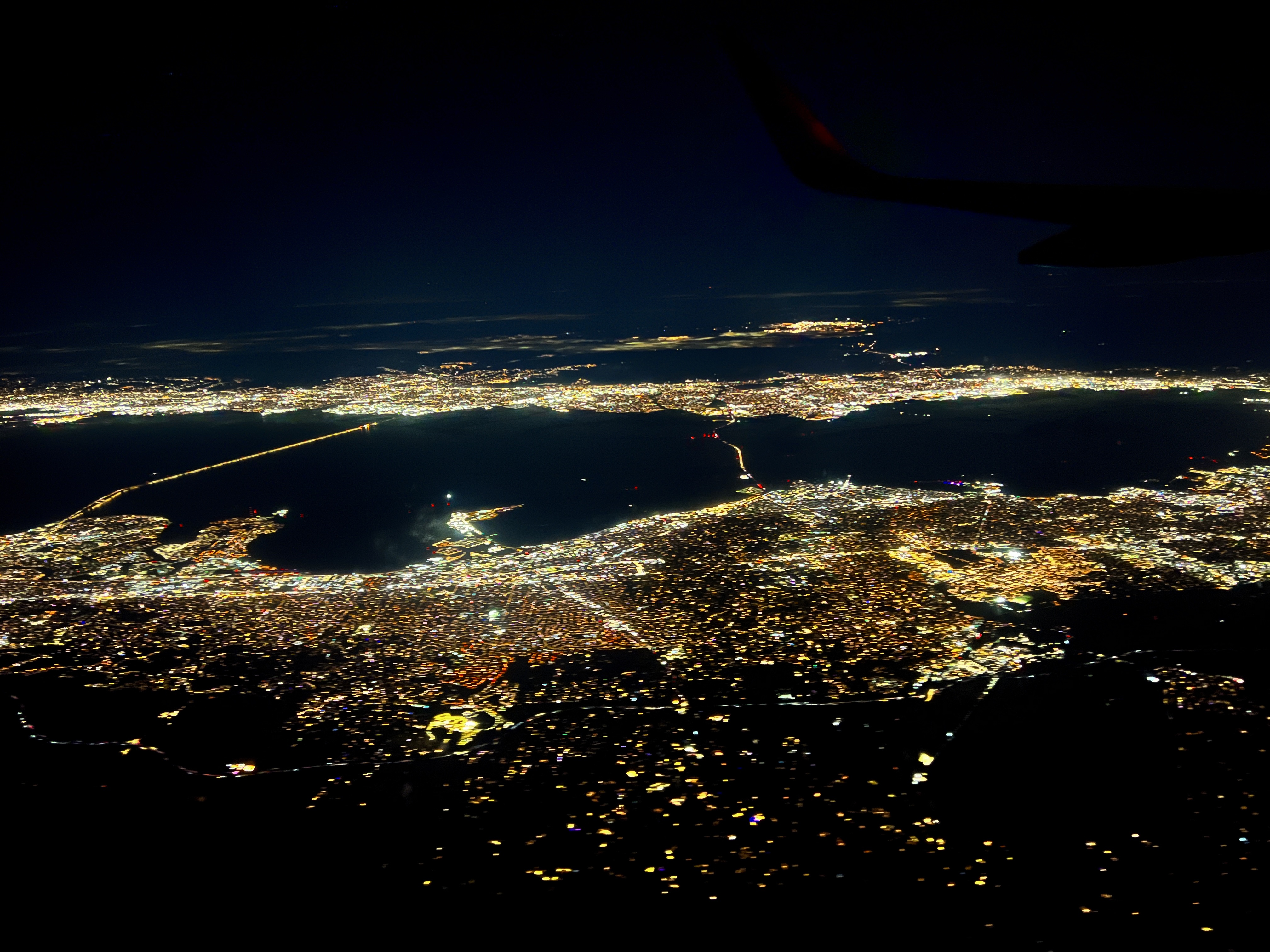
the bay from above
I’m on a plane back home right now, late in the night. For the first time in a while, I’ve landed a window seat. I didn’t expect much of it. Except now I feel like the luckiest man in the world.
It felt wrong to write that last sentence so hyperbolically, but that’s what the feeling was like. A feeling of awe and wonder so intense it stole my world for a moment. In that moment, time stalled, even as I kept moving, and I simultaneously felt the smallness and hugeness of my world.
Volander is one of many ineffable sorrows collated in The Dictionary of Obscure Sorrows. I left my copy back at school, but as I remember it, volander is the intense wave of awe that washes over you when you look out an airplane window and see truly how high up you are. Volander forcibly displaces you from your default perspective, so grounded in your day-to-day experience of your life, and launches you into this liminal ethereal nowhere. You are, not exactly anywhere in particular, because space has lost its relevance, and you have ascended, just for a moment, and you see. You understand.
As my plane soared to its cruising altitude, I leaned my head back. My eyes wandered toward the window, and then I saw. I saw the SF skyscrapers amidst the glimmering lights of metropolitan nights. I saw the star-studded runway of the airport I had just left, leading into the midnight-black abyss of murky bay waters. I saw the bridge from San Francisco to Oakland, cars and trucks drifting down the roads in slow motion. I saw San Mateo’s wondrous luminescence, sparking memories of spontaneous summer day trips, and the Dumbarton bridge by the Meta office, the center of my whole world last summer. I saw a triangle of darkness in the middle of Palo Alto’s lights, a dark imprint of Stanford’s outer land where I had been running just two days ago. I saw it all, all at once, and my eyes ascended.
I had had a geographic conception of the Bay Area, from looking at maps and taking the train and driving around. But if seeing is believing, then volander converted me from a mere parrot of geographic relations to a true evangelist of the world’s being. To have truly understood the world, not as some abstract array of locations that happens to be the backdrop of my life, but rather a true world, an unfathomably massive and continuous landscape of rich stories and memories for billions of humans. Volander had unlocked sonder. Sonder not just for every person in the world that had experienced but for every place in the world that had been experienced.
Reflections on What I Just Wrote
This is my first real blog post. I’ve had several other ideas recently, but with final exams, I’ve not given myself the mental space to do anything with them. When volander hit me earlier, I realized that I had no reason not to write, and so I started writing.
I took moral philosophy this quarter and a required class on oral and written rhetoric last spring, but that writing is distinctly different from the floral expression necessary for vividly communicating personal experiences. I’ve also been journaling in different forms for over 4 years now, but it often takes the form of stream-of-consciousness spewing, so it also hasn’t helped with my communication skills. My writing skills in general have atrophied, and this kind of writing in particular especially exposes that. I generally don’t use LLMs to write, but I have noticed that my default writing repeats generic phrase templates and sentence structures. I definitely want to work on that.
I don’t mind the writing or content quality of this post too much. It’s not bad for a first spirited attempt at personal writing for others. It’s also a first draft with no planning a priori, so I can’t judge it too much. I found it surprisingly hard to find good analogies (like with the “cars and trucks drifting down the road”—I wanted to find a vivid simile, but I just could not find a fitting comparison no matter how hard I tried), and I frequently found myself unable to find the exact words and phrasings that encapsulated the experience I was trying to convey. I imagine being able to pick exactly the right word and phrasing comes with reading and writing more to exercise that articulatory muscle. Having refined taste in word selection, especially inserting words in places that they normally don’t find themselves in a way that makes the meaning even sharper (wow that was a really windy wordy clause, case in point), is something I’ve wanted to have for a really long time, and hopefully through writing and reading more, I’ll start my journey. That’s really exciting to me.